How Long Does Air Duct Sealing Take in Winter Park Homes?
Your attic hits 130°F by July. We've measured it. And in most Winter Park homes built before 2000, every foot of flex duct running through that heat is leaking — not occasionally, but on every single cooling cycle, all year long.
After years of service calls across Orange County, the question we hear before almost anything else is: how long does this actually take? Here's what we tell homeowners: plan your morning. Most Winter Park homes finish in 3 to 6 hours, including the pre-service diagnostic and the post-seal report you'll hold in your hands before we leave.
What we've learned from working in homes throughout Baldwin Park, Dommerich Estates, and College Quarter is that the timeline conversation matters less than homeowners expect — and the comfort conversation matters more. Original flex duct from the 1970s and '80s doesn't fail dramatically. It fails gradually: joints separate a little, insulation pulls back a little, and conditioned air bleeds into the attic instead of reaching your rooms. The system compensates by running harder. The bill climbs. The back bedroom never quite cools down. Nobody connects it to the ductwork until we run the diagnostic and show them the numbers.
That's what this guide is built on — not general HVAC principles, but what we've actually found in homes like yours.
TL;DR Quick Answers
Air Duct Sealing in Winter Park
Winter Park homes run HVAC systems year-round against persistent humidity and attic temperatures that regularly exceed 130°F in summer. Many homes built before 2000 carry original flex duct systems that lose 20 to 30 percent of conditioned air through leaks. Professional air duct sealing in Winter Park uses Aeroseal injection technology to seal those leaks from the inside out — no demolition, same-day service, and a before-and-after diagnostic report at every appointment. Most jobs complete in 3 to 6 hours and pay for themselves within a few years through lower utility costs and improved system efficiency.
Top Takeaways
Most Winter Park homes complete air duct sealing in 3 to 6 hours — from pre-service diagnostic through post-seal verification and the final report.
Home size, duct layout, and leak severity determine where a job falls within that range — two-unit systems and complex configurations add time; single-story slab homes with simple layouts finish faster.
Aeroseal injection requires no demolition — sealant enters the duct stream, bonds at leak points from the inside out, and leaves no mess behind.
Florida's year-round HVAC demands make duct integrity more consequential here than in markets where systems rest seasonally.
Typical homes lose 20 to 30 percent of conditioned air through duct leaks — in Central Florida, that loss compounds across every cooling cycle of every month.
Every appointment ends with a before-and-after diagnostic report showing exact leakage rates in verified numbers.
Same-day completion is standard for residential duct sealing in Winter Park — plan your morning, and you'll have results before the afternoon.
What Happens During Air Duct Sealing? A Process Overview
Step 1: Pre-Service Diagnostic
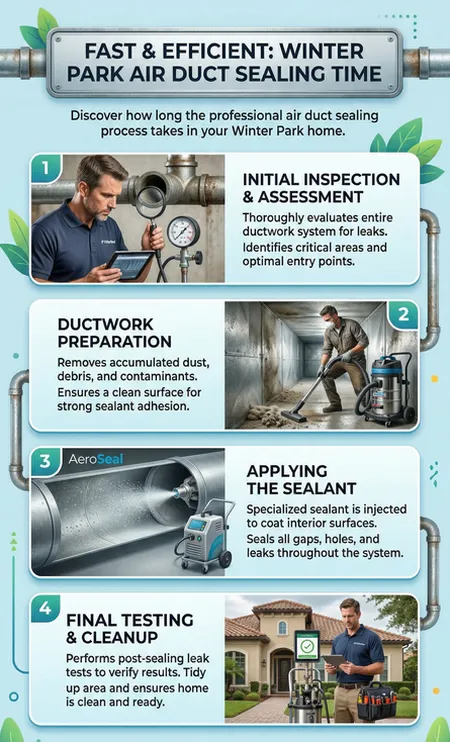
Before we touch anything, we measure. A blower door test and duct leakage assessment tell us exactly how much conditioned air the system is losing and where that loss concentrates. This phase typically runs 45 minutes to an hour.
Skipping it — or estimating around it — is how contractors end up guessing. We don't guess. The numbers we collect here set the baseline, shape the injection phase, and generate the before-and-after comparison you'll take home at the end of the appointment.
Step 2: The Aeroseal Injection Process
Aeroseal works differently than most homeowners expect. We pressurize the duct system and inject aerosolized sealant particles into the air stream. Those particles float freely until they find a gap, then stack up at the leak site and bond — sealing it from the inside out. No demolition. No wall cuts. No torn-up ceilings.
The sealant reaches leaks in wall cavities, behind finished ceilings, and deep in attic duct runs that no technician's hands could access any other way. It handles gaps from hairline cracks up to roughly a half-inch opening. The active sealing phase runs 1 to 2 hours, depending on what the diagnostic found.
Step 3: Post-Seal Verification
When the injection is complete, we retest the system using the same measurement protocol from Step 1. The before-and-after report you receive shows your duct leakage rate before we arrived and what it dropped to after we finished — in real numbers, not general claims. Most homes we service in the Winter Park area see leakage drop by 70 to 90 percent. That report is documentation worth keeping, and it matters at resale time or if your system ever gets formally inspected.
How Long Does Air Duct Sealing Take? The Real Timeline
Plan for half a day and you'll almost never be surprised. Here's how service time typically breaks down by home size.
Homes under 1,500 sq ft Total time runs 2.5 to 4 hours. Simpler duct layouts and fewer branch runs keep both the diagnostic and injection phases moving quickly.
Homes between 1,500 and 2,500 sq ft This is the most common range for homes in Winter Park's established neighborhoods. Expect 3 to 5 hours. One-story ranch homes with attic ductwork tend to finish closer to the 3-hour mark. Two-story homes with more complex branch configurations run longer.
Homes over 2,500 sq ft Budget 4 to 7 hours. Larger square footage, more duct runs, more zones. Larger homes in Windsong or near Mead Garden with multi-system configurations add a full additional diagnostic and injection cycle per air handling unit.
What Pushes a Job Toward the Longer End
A handful of specific conditions extend the timeline:
Severe duct leakage. Higher starting leakage means more active injection time to bring the system down to target specs.
Degraded attic duct runs. Florida's attic heat accelerates flex duct deterioration faster than cooler climates. Brittle material, separated joints, and sagging runs all add sealing time.
Tight or awkward access points. Air handler location, a small or poorly positioned attic hatch, furniture blocking key areas — these add setup time before technical work begins.
Two-unit or zoned systems. Each air handling unit needs its own full diagnostic and injection cycle. A home with two systems is effectively two jobs running back to back.
What Doesn't Add Time
Aeroseal requires no demolition, and that's worth saying plainly. We're not cutting into drywall, pulling up flooring, or removing registers. The process stays entirely within your duct system. For the large majority of Winter Park residential jobs, the house is back to normal the same afternoon.
Factors That Affect Duct Sealing Time in Central Florida Homes
From years of service calls throughout Winter Park and the surrounding communities, we see the same variables shape appointment length consistently. Here's what we actually find in the field.
Duct Material and Age
A significant share of Winter Park homes were built between 1970 and 1990 — years when flex duct was the standard installation method. That material gets brittle over decades. Joints separate. Insulation peels back. These systems carry higher baseline leakage rates, so the Aeroseal injection phase has more territory to cover. Homes with newer semi-rigid or properly installed metal duct tend to seal faster.
Duct Accessibility
Florida's slab-on-grade construction means ductwork almost always runs through attic spaces. Attic access in Winter Park homes varies significantly. A large pull-down staircase gives us room to move efficiently. A small hatch tucked behind closet shelving costs setup time before we can even begin. It's one of the first things our technician notes during the pre-service walkthrough.
Severity of Duct Leakage
A home losing 15 percent of conditioned air through leaks is a different job than one losing 40 percent. Both are common here. Both are fixable. The higher the starting leakage rate, the more injection time the system requires to reach acceptable specs.
System Configuration
Single-zone, single-unit homes are the most straightforward. Homes with two systems — one for upstairs, one for down — require two complete diagnostic and injection cycles. Multi-zone systems with bypass dampers add another layer of setup. If you're not sure how yours is configured, we'll sort that out during the diagnostic phase.
Is Air Duct Sealing Worth It for Winter Park Homeowners?
For most homes we assess in this area, yes — clearly.
The Energy Picture
A home losing 25 percent of its conditioned air through duct leaks isn't just uncomfortable. It's running its HVAC system at a sustained deficit, with the compressor and blower working harder on every cycle to compensate for what's escaping. Sealed ducts let the system reach your thermostat setpoint faster and maintain it more efficiently — and that difference shows up directly on your Duke Energy or OUC statement.
The Comfort Picture
Rooms that run warmer in summer or cooler in winter than the rest of the house almost always point to a duct problem, not a thermostat problem. When conditioned air escapes before reaching the room it was designed for, that room runs off-target regardless of where you set the dial. After sealing, distribution performs the way the original system design intended.
Humidity Control
This matters more in Central Florida than almost anywhere else. When return ducts leak, they pull unconditioned attic air directly into the system — air that's hot, humid, and carrying airborne particulates that bypass your filter entirely. Sealed return ducts mean your system only conditions the air it's supposed to handle.
Duct Sealing vs. Duct Replacement
Replacement isn't always the right call, and we'll tell you honestly when it is and when it isn't. When the flex duct is structurally intact, Aeroseal consistently delivers strong results regardless of the duct's age. Replacement makes more sense when runs are physically disconnected, severely crushed, or degraded past what injection sealing can address. We give you that read during the diagnostic phase — based on what we actually find, not on what generates a larger invoice.
How to Prepare for Your Duct Sealing Appointment
We keep preparation simple. Here's what actually makes a difference:
Clear a path to your air handler. Whether it lives in a utility closet, the attic, or the garage, make sure we can reach it without moving furniture.
Open up the attic hatch if it's behind something. Move anything stacked in front of it beforehand.
Plan to have an adult present for the pre-service walkthrough and the final diagnostic review. You don't need to supervise the work — just be available at the start and end.
Close windows and exterior doors before we arrive. We pressurize the duct system during injection, and sealed exterior openings improve measurement accuracy.
Expect a brief period without full HVAC operation. The system runs in a modified state during the injection phase — typically under two hours. It's temporary.
"Most Winter Park homeowners ask me the same thing before we start: do I need to clear my whole day? You don't. Plan your morning. What I've found, after years of service calls across Orange County, is that the timeline isn't what people remember anyway. What they remember is the back bedroom finally hitting the same temperature as the front of the house — and what their Duke Energy bill looks like the following month. Your ductwork is what everything else in your HVAC system depends on. A morning is a fair trade for getting it right."
Essential Resources
We only point customers toward sources that have earned their credibility. Every link below has been verified and reflects authoritative, independent guidance.
1. U.S. Environmental Protection Agency — Should You Have the Air Ducts in Your Home Cleaned?
The EPA's foundational consumer guide to duct maintenance: what warrants professional attention, what doesn't, and how to evaluate any service provider before you book.
https://www.epa.gov/indoor-air-quality-iaq/should-you-have-air-ducts-your-home-cleaned
2. U.S. Department of Energy — Minimizing Energy Losses in Ducts
The DOE's practical breakdown of how duct leakage drives up energy costs and what a professionally sealed system actually delivers. Includes guidance on when to call a qualified contractor rather than attempt repairs on your own.
https://www.energy.gov/energysaver/minimizing-energy-losses-ducts
3. ENERGY STAR — Duct Sealing
The EPA's ENERGY STAR program connects sealed ducts to verified energy savings and explains why duct integrity is a certification requirement for efficient homes — not just an optional upgrade.
https://www.energystar.gov/saveathome/heating-cooling/duct-sealing
4. ASHRAE — HVAC Systems and Equipment: Duct Construction Standards
The American Society of Heating, Refrigerating and Air-Conditioning Engineers sets the technical benchmarks for duct construction, sealing levels, and leakage testing that qualified contractors build their work against.
https://handbook.ashrae.org/Handbooks/S20/IP/s20_ch19/s20_ch19_ip.aspx
5. NADCA — A Beginner's Guide to Duct Sealing
The National Air Duct Cleaners Association's practical overview of sealing methods, approved materials, and inspection protocols. Homeowners who want to understand what quality service actually looks like before anyone shows up at their door should start here.
https://nadca.com/blog/beginners-guide-duct-sealing
6. U.S. Department of Housing and Urban Development — Seal and Insulate Ducts
HUD's independent energy conservation guidance confirms the financial case for duct sealing and provides context on the diagnostic tools — blower doors and pressurization devices — that qualified technicians use to measure leakage before and after the job.
https://www.hud.gov/program_offices/public_indian_housing/programs/ph/phecc/strat_h9
Supporting Statistics
Stat 1: Typical homes lose 20 to 30 percent of conditioned air through duct leaks.
In a typical house, about 20 to 30 percent of the air moving through the duct system escapes through leaks, holes, and poorly connected ducts — producing higher utility bills and persistent comfort problems regardless of thermostat setting.
Source: ENERGY STAR, U.S. Environmental Protection Agency
For Winter Park homeowners running systems year-round, that loss isn't a seasonal footnote. It compounds on every cooling cycle, every month of the year. From what we see on service calls throughout the 32789 and 32792 zip codes, that range is conservative for older flex duct installations. Most of those homes are losing more.
Stat 2: Leaky ducts add hundreds of dollars annually to heating and cooling costs.
Ducts that leak heated or cooled air into unconditioned spaces add hundreds of dollars a year to utility bills, and sealing them ranks among the most cost-effective improvements a homeowner can make.
In a market where "unconditioned space" means an attic exceeding 130°F in summer, every duct leak running into that heat is a compounding financial loss. The DOE's guidance is conservative by design. Homes with heavy attic duct leakage in climates like ours often see savings well above the national average.
Stat 3: Duct sealing reduces heating and cooling costs by 20 to 30 percent.
Research shows duct leaks typically raise a home's heating and cooling costs by 20 to 30 percent — and that professionally sealing and insulating those ducts reduces costs by the same margin.
Source: U.S. Department of Housing and Urban Development
That 20-to-30-percent range represents real money in a market like Winter Park, where summer utility bills peak hard. A homeowner spending $250 per month on cooling could see $50 to $75 back every single month after a single half-day appointment. Most jobs pay for themselves within a few years at that rate.
Final Thoughts and Opinion
The homeowners who benefit most from air duct sealing aren't the ones with the worst-leaking systems. They're the ones who stop waiting.
Most duct systems degrade gradually. Leakage increases by degrees. Energy bills climb in increments too small to trigger a call. The back bedroom gets a little warmer. The system runs a little longer. The filter loads up faster than it used to. None of it is dramatic. All of it adds up, month after month, year after year.
What we find consistently across Winter Park service calls is that by the time a homeowner books an appointment, they've been absorbing the consequences for years. The diagnostic report we generate — showing before-and-after leakage rates in actual numbers — produces the same reaction almost every time: I wish I'd done this sooner.
Air duct sealing in Central Florida isn't a luxury upgrade or a niche service for energy enthusiasts. Given what we ask of HVAC systems here — continuous operation, extreme attic temperatures, relentless humidity — it's basic infrastructure maintenance. The time investment is modest. The impact on daily comfort, indoor air quality, and monthly utility costs is not.
If your home went up before 2000, if you've never had your ducts tested, or if any room consistently runs off-temperature, that's your signal. One morning. One appointment. One report that shows exactly what changed and why.
Frequently Asked Questions
1. How long does air duct sealing take in a typical Winter Park home?
Most residential air duct sealing jobs in Winter Park run between 3 and 6 hours from start to finish. That includes the pre-service duct leakage diagnostic, the Aeroseal injection phase, and post-seal verification with a printed before-and-after report. Single-story homes under 1,500 square feet often finish closer to 3 hours. Larger two-story homes, or properties with two HVAC systems, run longer — up to 7 hours when both units need full diagnostic and injection cycles.
2. Do I need to leave my home during the duct sealing process?
You can stay home throughout the entire appointment. Aeroseal is clean, contained, and works entirely within your duct system. We ask that you keep windows and exterior doors closed during the injection phase to maintain accurate system pressure, and that someone is available for the pre-service walkthrough and the final diagnostic review. Constant supervision isn't required.
3. What is Aeroseal and how does the duct sealing process work?
Aeroseal is an injection-based duct sealing technology. We pressurize your duct system and introduce aerosolized polymer particles into the air stream. Those particles stay suspended until they reach a leak, where they accumulate and bond to seal the gap from the inside out. The process reaches leaks behind walls, inside finished ceilings, and in attic duct runs — without any demolition. It handles gaps from hairline cracks up to approximately a half-inch.
4. How much can I save on energy bills after duct sealing?
Savings depend on your home's baseline leakage rate and your current utility costs. The U.S. Department of Energy confirms that leaky ducts add hundreds of dollars annually to heating and cooling costs. ENERGY STAR data shows typical homes lose 20 to 30 percent of conditioned air through duct leaks. For Winter Park homeowners with significant leakage, monthly savings of $50 to $100 or more are realistic, meaning most jobs pay for themselves within a few years.
5. How do I know if my Winter Park home needs duct sealing?
The most common signs are uneven room temperatures throughout the house, energy bills that seem high relative to your home's square footage, rooms that won't reach the thermostat setpoint, and faster-than-expected filter loading. Homes built before 2000 in Winter Park — especially those with original flex duct systems — are strong candidates for a professional assessment. The only definitive way to know your leakage rate is a diagnostic test, which we run at the start of every appointment before any work begins.
Ready to Stop Losing Conditioned Air?
Schedule your Winter Park air duct sealing appointment today and leave with a same-day diagnostic report showing exactly what changed in your ducts, your comfort, and your energy costs.
Here is the nearest branch location serving the Winter Park area. . .
Filterbuy HVAC Solutions
2900 Titan Row # 128, Orlando, FL 32809
(407) 204-1859
https://maps.app.goo.gl/Weuf8AhtuRP4H855A